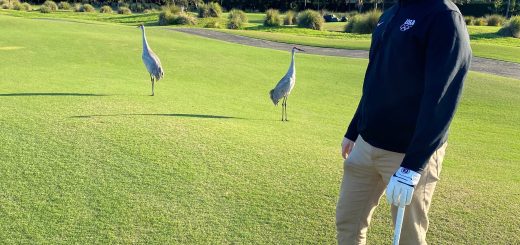

Learning From The Pro's Date Posted: 2009-10-25 09:58:36
The week of October 19th through the 25th the top 50 player's on the Nationwide Tour gathered at the Daniel Island Club in Charleston, SC for the season ending Tour Championship. There was much more at stake this week than usual. At the conclusion of this weeks tournament, the top 25 player's on the seasons money list will earn exempt status for the 2010 season on golf's grandest stage, the PGA Tour. Big deal you say. Consider this... The avaerage purse each week on the Nationwide Tour this year is about $600,000. The average purse on the PGA Tour is about $6,000,000. That right, six million. Not convinced yet, well then consider this... The 25th ranked player on the Nationwide money list so far this year has earned $165,000. The 25th ranked player on the PGA Tour has earned $2,400,000!!! But wait, it gets better!!! The 100th ranked player on the Nationwide money list has earned $55,000. The 100th ranked player on the PGA Tour has earned $800,000. I would say that it doesn't take a math genius to figure out that playing on the PGA Tour is more lucrative than playing the Nationwide. I'd even be willing to bet that the perks and fringe benefits are better on the big tour as well!! So hopefully now you can understand just exactly what's at stake for 25 guys this week.
Although I spend the vast majority of my time teaching and coaching at the Junior Player's Golf Academy, I still consider myself a student of the game. Ever since I can remember, I have always been very inqusitive and curious about the various facets of golf. Things like studying different swings and what makes them work, watching great player's and taking note of how they do things, and spending countless hours thinking about the mental aspects of golf are just a few of the many things that have consumed my mind over the last quarter century or so. Going back to my early teenage years I have always enjoyed going to PGA Tour events and watching the best player's in the game. I now look at it as a "cleansing of the golfing soul". It's something that I have to do at least once a year no matter what. Watching their fluid swings and the penetrating ball flights that they produce revitalizes my golfing juices and gives me a shot of energy.
So all that being said, here are a few interesting things that I noticed during my Pilgrimage to Charleston for Saturday's third round action.
1. No two swings are the same. I have been to countless professional tournaments over the years and this has always been the theme. Each player has his own way of hitting the ball great. So much for the one swing fits all theory!
2. They all hit it dead solid nearly every time. Notice that I said nearly every time. I saw a fair share of, shall we say, "not so great" shots as well. Even the pro's hit poor shots from time to time, but not too often.
3. Body language and reaction. As I mentioned above, I witnessed some bad shots first hand. The thing that surprised me the most was their lack of negative reaction to the offending shot. Instead, they very quietly and calmly placed their club back in the bag and carried on as if they had done no wrong. They are in TOTAL control of their thoughts and emotions, not the other way around. Perhaps this surprised me so much because I have become so accustomed to watching much less skilled junior golfers have a seizure after every bad shot. Are you juniors listening??? The best players in the world don't go bananas after a bad shot. Neither should you!!!
4. Great putting. I know, I've said it a thousand times before, but it's worth mentioning at least another thousand times. These guys putt great!!! Their lag putting is absolutely phenomenal. I watched several 30-60 foot undulating putts rolled to within easy tap in range. Junior golfers don't putt well enough to score like a pro and this is one reason why. Develop great touch!!!
5. What's in the bag? Golf is like no other sport. It affords the spectator the opportunity to get closer to the action and the players than just about any other sport. It may be the only game where the players may occasionally engage in conversation with the gallery. In fact, you can usually get so close it is possible to see what club the player has hit for a particular shot. You can also see what type of club a player is playing. Don't let the names on the hats and bags fool you. Some of these guys are not playing the equipment that their hats and bags may suggest. Although they may be getting paid to wear a certain hat or have their name on the bag of a certain equipment manufacturer, when it comes right down to performance, these guys are playing what works the best for them. You should to. I noticed that many players were using drivers that were not the most current model. They found something they liked and they stuck with it. Don't play certain equipment just because your favorite player does. Play it because it's the best for you and your game.
The drive home was long and boring but gave me time to think. What is the difference between guys who are playing for six million dollars each week versus guys who struggle to make cuts in the minor leagues of golf? If you watched the swings of both players side by side you may not be able to tell which guy earned $800,000 and which guy earned $55,000. I guess it just goes to show that there must be more to it than one could ever imagine...
Brian Moore
Director of Instruction
Junior Players Golf Academy |
Junior Players Golf Academy Tournament Update Date Posted: 2009-10-14 13:49:15
The weekend of October 5th and 6th brought some of the students of the JPGA Academy to the Oyster Reef Golf Club on Hilton Head Island for another IJGT event. The weather was perfect and the course was in immaculate shape for the field as they faced a stern test of golf on the tree lined Oyster Reef layout. The JPGA had 4 players finnish in the top 10 in the boy's 16-18 year old age division.
Boomer Malanchuk and Marco Polanco both finished tied for 2nd place with rounds of 73-72
Michael Antona finished in 5th place alone with rounds of 76-72
Ross Kronberg finished 10th with rounds of 75-77
In the boy's 13-15 age division Diego Schiffino finished in 2nd place with rounds of 76-74
The next weekend took the Junior Players Golf Academy to Eagle Creek Golf Club in Orlando, Florida for our first Future Collegiate World Tour Event. The weather was hot and sunny for the player's as they faced a long and wide open course.
Marco Polanco and Ruben Van Uden finished tied for 5th with rounds of 71-73 and 74-70 respectively
Michael Antona finished tied for 7th with rounds of 75-70
Boomer Malanchuk finished tied for 9th with rounds of 74-72
Colin Hendrickson finished 12th with rounds of 80-68
Tim Cary finished tied for 13th with rounds of 76-73
Zach Boe finished 19th with rounds of 78-74
This week the team will head to the Port Royal Golf Club on Hilton Head Island for an IJGT event. Stay tuned for more great news from the Junior Players Golf Academy. |
Junior Golf: Doing It The Right Way! Date Posted: 2009-09-20 11:29:28
Getting a junior golfer off to a good start may be the most important phase of their golfing career. There are many paths that a junior golfer and their parents can take on the journey of learning golf and I will attempt to offer some helpful advice that will hopefully keep you away from too many dead ends.
1. First of all the game must remain a fun game. It puzzles me when I see junior golfer's (and adults as well) come off the 18th green in a miserable mood. We all know that golf can test our patience, especially if we have put in many hours of hard work only to seemingly fall short of our expectations. This being said, it is important to remember that golf is just a game and should be treated as such.
2. Work hard but keep a well balanced lifestlye. If golf is all you do then golf is all you have. When you're at the course give it your all. When you leave the course leave the game there as well. Junior's should have other activities in life that they take part in. Golf should not be the only thing in their lives as this leads to an out of balance lifestyle. They should be encouraged to play other sports, "hang out" with friends, and enjoy their teen years.
3. Learn to take breaks from the game. This is very hard for some serious player's to do, but trust me, it's an absolute necessity in order to avoid burnout. My position as Director of Instruction takes me to several large scale junior tournaments each year and I see what I would call "Golf Zombies" walking around. These are kids who have played and practiced so much with out a break from the game that they are just "going through the motions". They are completely burned out and don't even know it. Imagine this.... You have a very sharp saw used for cutting wood. If you cut a lot of wood but never stopped to sharpen the saw (take a break) it would eventually dull and not cut as well. Taking periodic breaks from the game allows you to come back with more focus and a sense of being recharged. As the old saying goes "Absence makes the heart grow fond".
4. Leave junior alone!!! For some well meaning parents this advice seems to be impossible to follow. Having spent the majority of the last 25 years or so hanging around on driving ranges I can't tell you how many times I have been within earshot of some well meaning parent trying to "help" their young son or daughter. The best way to get a young child interested in golf is to let them do it "their way" for now. Don't correct their grips. Don't correct their stances. Resist the burning itch to correct their faults after every swing. Let them do it however they want. As a parent you have only two jobs. The first is to tell your youngster how great he's doing and the other is to keep quiet and stay out of the way. If they happen to get bit by the golf bug there will be plenty of time and opportunity for formal instruction later on down the road, preferably by a qualified expert. While we're on the subject it might be worth noting that children tend to do better at anything when instruction comes from someone other than mom or dad. I know of a very famous instructor who has a very well accomplished son playing the game and this instructor had the good sense to have one of his staff instructors teach the boy during his junior years. Parents- please, please resist the uncontrollable urge to "help" and keep your distance.
5. Make sure junior has properly fitting equipment. In the paragraph above I said that a parent has only two jobs but I forgot one more very important job. That is to make sure that your child has properly fitting equipment. This is one area that you do need to take a more hands on approach. This catagory is all to commonly over looked and the results can be long lived and disasterous. Many swing faults that juniors develop stem from having equipment that was too long and too heavy for them in their formative years. Grandpa's hand-me-downs are usually the culprit. It is very important for a junior to have clubs that are short and light enough for them to swing with control and speed. Adult clubs, even cut down clubs, are still too stiff and too heavy. The grips must also be small enough for their little hands to fit around correctly. As the child grows, so to must his clubs. Please don't make the serious mistake of buying clubs that junior will "grow into". The underlying idea here is to save a few bucks and "time" growth spurts with clubs that are, for now, too long. By the time he or she does grow into them it will be too late. The price that you pay to keep equipment current is very small compared to the price junior will pay trying to undo the many swing habits caused earlier by poorly fitting equipment.
Some additional thoughts for parents...In my years as a teacher, I am yet to meet a parent who describes their son or daughter to be of "average" talent or ability. Nearly every parent describes their child as "exceptional" or a "natural". More often the case is a proud parent making their best effort to represent their son or daugher in a positive light. If every kid were a prodigy, as their parents describe them, then "average" would be extinct. I make this point half joking and half serious because as parents you must remember to be realistic in your expectations about your child's future in the game. Becoming a star golfer is a lot like becoming a movie star... many set out to do it but in the end only a few make it. Let the game take them where it does. If this means on to college and beyond into the pro ranks then great. If it teaches them the skills of life such as patience and persistence then priceless!!! It was all worth it. I have never met anyone who looked back and said "I wish I had never learned to play golf" and been serious about that statement.
Brian Moore
Director of Instruction
Junior Player's Golf Academy |
The Anatomy of Great Scoring Date Posted: 2009-09-18 11:27:01
There are many different aspects and areas of the game that make up our score. They range from the long game, the mental and course management part, to short game and putting. While it's true that all shots count the same, one stroke, there are some shots that seem to carry more weight in separating the good scores from, shall we say, the not so good. When most people sit down to analyze their rounds at the completion of play they generally count how many fairways and greens they hit, how many putts the had and so on. These general stats are nice to keep in mind but they don't always tell the whole story. For instance, if you happen to have a day where you hit several greens in regulation (which is great!) your total number of putts would generally tend to be higher than if you hit fewer greens and were forced to chip more often.
After analzing many rounds over the years I have come up with a few categories that I think are important to be great in to shoot really good scores. They are:
1. Putting from 2-10 feet. This may be the most telling tale of your total score. For the sake of conversation we will concede all putts inside 2 feet. If you have both hands on the putter and take care, you should have no problems from this range. However, putts in the range of up to 10 feet are very makeable yet seem to be missed with great frequency, particularly during bad rounds. Imagine this.... What if you were 100 percent from 10 feet and in? How bad could your score possibly be? Although being perfect from this 2-10 foot range is unrealistic, it would do your score wonders to improve your percentage from this vital distance. Statistics have shown that once you are putting from more that 10 feet your odds of holing the first putt are drastically reduced. Win the battles that you have a chance to win. Be great from 10 feet and in!!!
2. Driving the ball in play. Notice that I said "in play". While length is a tremendous advantage off the tee, nothing is more important than getting each hole off to a great start. Straight driving puts you on offense, but with poor driving you usually wind up playing defense all day. It's pretty tough to score a touchdown if your team is on defense. Let me define "in play". An in play tee shot is one that allows the advanced player to have a very reasonable opportunity to reach the green in regulation and a less skilled player to have a clear shot to advance the ball into a good position for their next shot. A playable tee shot may come to rest in the fairway or even in light rough. Unplayable tee shots are usually the root cause of big numbers on the card. They include hitting into water, deep woods, or by far the worst, out of bounds!
3. Great chipping and pitching. The ability to control the ball around the greens will allow you to get the ball close enough to the hole to save par when you, dare I say it, miss the green! If you can chip and pitch the ball to a few feet fairly consistently you will really shave strokes off your score. See rule #1 above.
A few things to ponder....
1. According to shotlink, Tiger Woods ranks #1 on tour in putting from 3-5 feet at a staggering 94.4 percent!!
2. Why do junior golfers come off the 18th green moaning about how many putts they had and then proceed directly to the practice range?
This week there are 6 student's from the Junior Player's Golf Academy competing in the IJGT event at Champions Gate near Orlando, Florida. Best of luck and bring home a trophy!!!
Brian Moore,
Director of Instruction
Junior Player's Golf Academy |
The First Month of the 2009 Season Date Posted: 2009-09-16 08:53:40
The first month of the 2009 Junior Player's Golf Academy is now in the books and we are off to a great start. We have doubled in size from last year and we have some great talent on our hands. Many of the students have played in their first tournament already and some student's have played in two events and the results have been great.
The first tournament was an IJGT event held at Tradition National Golf Club in Hardeeville, SC September 5th-7th
In the boys 16-19 division JPGA student Boomer Malanchuk shot rounds of 76-71-73 for an 8th place finish and Tim Carey shot 74-73-74 for a 9th place finish. The big news for the week however came from JPGA student Diego Schiffino who became the first male student of the JPGA to win an IJGT event. Diego carded rounds of 70-73-72 for a three round total of one under par to win by one. Great job Diego!!!
On September 12th and 13th the IJGT Tour moved down the road to Eagles Point Golf Club in Bluffton, SC.
In the boys 16-19 division the JPGA had 4 students finish in the top 10 in a field of over 50 players. Leading the way was 17 year old Colin Hendrickson of Loveland, Colorado who finished in a tie for 3rd place with rounds of 70-72. Colin fared well playing in his first event of the season and handled the pressure of playing in the final group on Sunday. Finishing in 6th place was Marco Polanco of the Dominican Republic shooting rounds of 75-69. In 8th place from Kenilworth England was Michael Antona with rounds of 76-71. In 9th place was Boomer Malanchuk from Virginia finishing 9th with rounds of 77-71.
Stealing the show for the second week in a row was Diego Schiffino of the Dominican Republic carding rounds of 71-73 for a 9 shot win in the Boys 13-15 division. Two tournaments, two wins. Could this be the beginning of a Tiger like season? Stay tuned to find out.
The next IJGT event takes place in Orlando at the Champions Gate Resort near Orlando, FL September 19th and 20th where many of our post graduate students will be competing. Good luck guys!!!
Brian Moore
JPGA Director of Instruction |
Looking Forward to a New Year Date Posted: 2009-05-29 22:36:13
The Junior Players Golf Academy just completed it's year and has recently said goodbye to all the students who attended the 2008/2009 program. It was a very successful year with all the players taking their games to the next level. We had some wins on the FCWT Junior Golf Tour as well as the International Junior Golf Tour and the Junior PGA Tour. Several students also finished in the top 5 and 10 in some National events.
We look forward to the new students and some repeat players joining us in mid August for the 2009/2010 program. Let us know if you are interested in coming to Hilton Head and seeing why the JPGA is the best academy in the south.
The Junior Players Golf Academy (JPGA) is located on Hilton Head Island, SC. We offer full-time programs for Academic and Post-Graduate students as well as junior golf schools and junior golf camps during the summer and holiday breaks. For more information, please call us at 843.686.3355. |
Tour Championship at PGA National, May 22th-25th, 2009 Date Posted: 2009-05-24 19:44:23
All of our students who attended the Junior Players Golf Academy on Hilton Head Island in South Carolina this year are competing in the FCWT Junior Golf Tour Championship at Palm Beach Gardens, FL this weekend.
Players in bold are JPGA Students
After a full day of "waiting" out the rain yesterday, players arrived at the golf course on Sunday, to wait once more. After a short delay (in comparison to Saturday's all day wait), the Morning Wave took to the course. At 11:15am they were delayed once more, then resumed play around 1pm. The Morning Wave is now finish and has to wait again for the scores from the Afternoon Wave who took to the course around 5pm. Once all players have completed the round a cut will be made.
The Morning Wave has a three-way tie for the lead with Garrett Newman of Zion, IL (2010), John Gordy of Bloomfield Hills, MI (2010), and Kevin Jorden of Juno Beach, FL (2011) all carding a 73. Their likelihood of making the cut is pretty probable at this point. Sean Ko of British Colombia, CANADA (2010) had the 4th best score of the morning wave with a 74. Ko earned his way into the event by a special exemption via the Maple Leaf Junior Golf Tour. Four players posted a 75: 15 year old Oliver Vaidis of Bradenton, FL (2012), Parker Freiburg of Quincy, IL (2009), who finished 4th at Whistling Straits, Patrick Cansfield of Port Huron, MI (2010), and Theo Lederhausen of Hinsdale, IL (2010). Five players are in at 76: Mills Rendell of Winnetka, IL (2010), Guan Huang of Sichuan, CHINA (2010), Matt Campbell of York, ME (2010), Tim Denenberg of Winnetka, IL (2010), and Derek Wilcox of Miami, FL (2009).
Marten Bosch of HOLLAND carded the only eagle in this group with a 2 on the par 4, 2nd hole. Garrett Newman and Matt Campbell co-led in birdies with 5. Bosch is currently tied at 14th with 77. Andrew Fisher from Victoria B.C. Canada is Tied for 23rd with 78.
|
FWCT - Tanglewood, NC Date Posted: 2009-03-23 14:12:06
The golfers of the Junior Players Golf Academy located on Hilton Head Island, South Carolina truly experienced what "toughing it out" really meant this past weekend in Clemmons, North Carolina at the FCWT Tanglewood Classic Tournament.
On Saturday, the temperature averaged around 36 degrees Farenheit, including cold rain and winds. Sunday, the second round was cancelled due to heavy rain. Through the tough conditions though, several were able to persevere and put together a solid round on Saturday.
Courtney Boe led the Girls 13-18 division with an impressive round of 77. Axel Bakal and Parker Wingfield tied for 7th place also with rounds of 77. Of the Boys 13-15 division, Andrew Holloway was able to grab a third place title with a round of 82.
Good job to all those who managed to pull through 18 holes, even for the advanced player, it was not an easy task. |
What to Look For in An Academy Date Posted: 2009-03-01 12:05:32
If you are out there searching the World Wide Web for schools or academies to attend for yourself or your son or daughter, you need to consider a few things.
The first thing is the value for the price. What are you getting for the hefty tuition you will be paying. At the JPGA, Junior Players Golf Academy on Hilton Head Island in South Carolina we are all inclusive. This means, once you pay the tuition you will not be nickled and dimed everytime you turn around. We include everything from food to housing, to instruction and golf. We even include tournament entry fees, membership fees, and all travel expenses from lodging to food and also transportation on the FCWT Junior Golf Tour.
The JPGA, Junior Players Golf Academy also has a 4 to 1 student to teacher ratio. This is vitally important if you want to learn anything. Unfortunetely other academies can't afford to lower their ratio, therefore they have as much as 14 to 1. As a student, you can't learn anything with 13 other students starving for instruction! The massive overhead these other academies have limits them on the Quality, therefore they focus more on the Quantity!
Housing is very important, students need a nice surrounding to make them feel comfortable and feel like they are at home. The JPGA, Junior Players Golf Academy offers housing which is top of the line. Some parents wish they were attending just because the housing is better than their own. Food is extreamly important, we have a house parent who cooks home cooked meals each night so the students can receive the nutition they need in order for them to be healthy and perform.
These are a few things you need to keep in mind when you are researching Full Time Academies like the only academy on Hilton Head Island, the JPGA, Junior Players Golf Academy. |
Practicing With A Purpose Date Posted: 2009-02-23 15:01:26
In order to be successful in the game of golf, a player must be skillful mentally and physically. Unfortunately, in golf, practice will never make perfect. Practice regimes must be effective and focused on the areas that are needing the most attention, in order for any improvement to take place.
A good way to start practicing with a purpose is to set goals for yourself and be organized. Find out through playing and keeping statistics to see what areas of your game needs the most improvement. Creating a plan for your path to improvement is the first step. You won't get anywhere fast going out to the range with a bucket of balls searching for the perfect hit.
Make sure you keep track of your progress as well. If in the beginning you had too many putts, make sure you are recording how many putts you had in a round and comparing it to your previous numbers. If you found that you weren't making any ups and downs, record that as well. Any sort of statistic you can collect will help and start you on the road to better golf and lower scores.
At the Junior Players Golf Academy (JPGA) in Hilton Head Island, SC, I challenge myself in practice everyday and always set up a practice station, no matter what part of the game I am trying to focus on. Setting up practice stations can help pass the time in practice and can be a true test of my abilities as a golfer.
Phyllis Langley
JPGA Post-Grad |
| Page: « 1 2 3 4 5 6 » |
|
|
Topics
|