
Most Common Golf Penalties and How to Avoid Them?
A rules guide by Keith Bach – PGA Member, and the president of JPGA
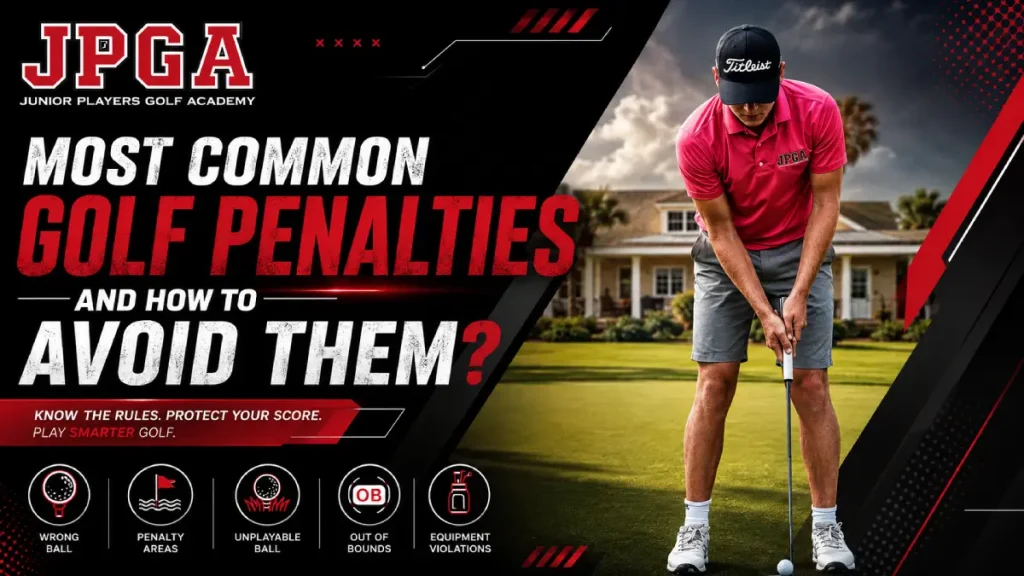
Golf is one of the only sports where you’re expected to call penalties on yourself. No referee standing over your shoulder. That’s part of what makes the game special, but it also means you need to actually know the rules, not just guess at them.
I get asked about penalties constantly, from juniors at the JPGA to weekend players who just want to stop bleeding strokes. Below are the penalties I see most often on the course, based on the current Rules of Golf, along with practical ways to avoid each one.
A quick heads-up first: the rules changed quite a bit in 2019 and have been fine-tuned again since, most recently in 2023. If you learned golf a decade or two ago, some of this will be new to you. “Water hazards,” for instance, are now called “penalty areas,” and they’re not just for water anymore. More on that below.
Our Locations
Hilton Head Island, SC
2 Finch Street
Hilton Head Island, SC 29926
Orlando, FL
16301 Phil Ritson Way
Winter Garden, FL 34787
Phone: (843)-686-3355
QUICK REFERENCE: 6 PENALTIES AT A GLANCE
- Wrong ball: 2 strokes (stroke play) / loss of hole (match play)
- Unplayable ball: 1 stroke
- Penalty area: 1 stroke, if relief taken
- Cleaning ball at wrong time: 1 stroke
- Lost ball / out of bounds: stroke and distance
- Equipment violation: 2 strokes per hole, capped at 4
1. Playing the Wrong Ball
THE PENALTY
Two strokes in stroke play • Loss of hole in match play
If you hit a stroke at a ball that isn’t your ball in play, and it’s not a provisional or a substituted ball you’re allowed to play, that’s the cost. You then still have to go find your actual ball and play it, unless it’s lost, in which case you’re dealing with a separate penalty on top of it (see lost ball, below).
How to avoid it:
- Mark your ball with a personal marking, in addition to the brand and number already printed on it.
- On a crowded course, two players in your group are often playing the same ball model and number. This happens more than people think.
- Glance down and confirm it’s yours before every swing. Two seconds, saves two strokes.
2. Declaring Your Ball Unplayable
THE PENALTY
One stroke
You’re the only person who can make this call. Not your playing partner, not your caddie.
Why take a penalty instead of just hitting it? I’ve seen plenty of situations where it’s the smarter play. A ball buried under a shrub or wedged against a rock isn’t worth risking your equipment, or your wrist, to save one stroke.
Your three relief options (all for one penalty stroke):
- Stroke and distance: go back to where you played your previous shot and play again.
- Back-on-the-line relief: pick a spot on the line running from the hole through where your ball lies, go back as far as you want on that line, and drop. Since the 2023 rule update, the ball just needs to land within one club-length of where you dropped it.
- Lateral relief: drop within two club-lengths of where your ball lies, no closer to the hole.
If your ball is unplayable in a bunker, options two and three require you to stay in the bunker. There’s also a fourth option, for two penalty strokes, that lets you drop outside the bunker entirely.
3. Penalty Areas (Formerly "Water Hazards")
THE PENALTY
One stroke, if you take relief.
- Play it as it lies, no penalty at all, if you’re confident you can make contact.
- Take relief for one penalty stroke. Your options depend on the stake color:
| Stake Color | Relief Options |
|---|---|
| Yellow | Stroke and distance, or back-on-the-line relief |
| Red | Same as yellow, plus lateral relief within two club-lengths of where the ball last crossed into the penalty area |
4. Cleaning Your Ball at the Wrong Time
THE PENALTY
One stroke.
You generally can’t clean a ball that’s in play. The exceptions: your ball is on the putting green, or you’ve lifted it to identify it or check whether it’s damaged and unfit for play (cracked or cut).
How to avoid it:
if you’re not on the green and haven’t lifted your ball for one of those approved reasons, leave it alone. I see this most with players who are frustrated after a bad shot and instinctively wipe the ball off out of habit. Slow down and think about where you are on the course before you touch it.
5. Lost Ball and Out of Bounds
THE PENALTY
Stroke and distance. One added stroke, and you play again from your previous spot.
This might be the single most expensive penalty in golf for the everyday player. A ball that goes out of bounds off the tee effectively costs you two strokes before you’ve even hit your next shot: one for the shot itself, one for the penalty.
How to avoid the damage:
- Hit a provisional ball anytime you think your original shot might be lost or out of bounds.
- Announce it as a provisional before you hit it.
- Play it before your three-minute search window runs out.
- Find the original in bounds within that window? Pick up the provisional, continue with the original, no harm done.
- Don’t find it? The provisional becomes your ball in play, and you’ve saved yourself the walk back to the tee.
It costs nothing to hit a provisional. It can save you a lot of time and frustration.
6. Equipment Violations
THE PENALTY
Two strokes per hole where the violation occurred, capped at four strokes total in stroke play (two holes in match play)
The most common one I see is carrying too many clubs. The limit is 14. Tee off with 15, or add a club mid-round and go over the limit, and the penalty kicks in. The same general structure applies to other equipment issues, like a nonconforming club or an illegal ball.
How to avoid it:
Count your clubs before you leave the parking lot. I make our junior players do a physical count at the range before every round until it becomes second nature. Ten seconds, and it’s one of the easiest penalties in the whole rulebook to avoid completely.
The Bigger Picture
Every one of these penalties tends to come from the same place: not knowing the rule, or not slowing down enough to apply it correctly in the moment. It’s rarely bad luck. Golf rewards players who understand the rulebook nearly as much as it rewards players who can strike the ball well, and I’ve watched plenty of solid ball strikers give away strokes on things that had nothing to do with their swing.
My advice to anyone in our program: read through the Rules of Golf at least once, even if you never memorize the finer points. Know the basic penalty structure for the situations you’re most likely to run into: wrong ball, unplayable lies, penalty areas, and lost balls. Those four cover the overwhelming majority of penalties recreational golfers actually take.
If you’re ever unsure at the moment, mark the spot, note the situation, and ask your group or a rules official once you’re off the hole rather than guessing. Golf hands you the responsibility of calling your own penalties. Take it seriously, and it’ll serve your scorecard well.
Frequently Asked Questions
Do I have to report my own penalties even if no one saw it happen?
Yes. Golf runs on an honor system, and that’s true whether you’re playing a casual round or a sanctioned event. If you know a rule was broken, you’re expected to apply the correct penalty to your own score.
What's the difference between stroke play and match play penalties?
In stroke play, most penalties add strokes directly to your score for that hole. In match play, many of the same breaches instead cost you the hole itself, rather than a specific number of strokes.
Can I ask my playing partner for rules advice during a round?
You can ask about procedure, like how to take relief correctly, but you cannot ask for advice on strategy, such as club selection or which shot to play. That distinction still trips people up, including experienced players.
Is a two-stroke penalty always worse than a one-stroke penalty?
Not necessarily. A one-stroke penalty for an unplayable lie in a bad spot can sometimes save you from a far worse outcome, like an unforced error trying to play an impossible shot. Think about the situation, not just the number.
Where can I find the full, current Rules of Golf?
The USGA and The R&A jointly publish the official rulebook, and it’s available on both organizations’ websites. I’d also encourage you to bring specific situations to your coach rather than trying to interpret every gray area on your own.
How many strokes is a water hazard, or penalty area, in golf?
One stroke, if you choose to take relief. This is the same whether you’re using the older term “water hazard” or the current term “penalty area.” The stroke penalty applies when you drop a ball to get out of the trouble rather than playing it as it lies. If you’re able to play the ball as it lies in a penalty area, there’s no penalty at all.
What is a 2 stroke penalty in golf?
A two-stroke penalty is the standard “general penalty” in stroke play for more serious rule breaches, things like playing a wrong ball, playing from a wrong place, or carrying too many clubs. It’s added directly to your score for the hole where the breach happened. In match play, most of these same breaches cost you the hole instead of a fixed number of strokes.
Is a water hazard always a 2 stroke penalty?
No. Taking relief from a penalty area, what used to be called a water hazard, is a one-stroke penalty, not two. The two-stroke penalty applies to a different category of rule breaches entirely, like playing the wrong ball or an equipment violation. It’s an easy mix-up, so worth keeping separate in your head.
Learn the Rules the Right Way, With JPGA
Reading about penalties is a start, but most golfers really learn the rules by working through real situations on the course, with someone who can walk them through it in the moment. That’s exactly how we approach it at JPGA.
Our coaching programs build rules literacy into regular practice, not as a separate lecture, but as part of how we train. Players learn to recognize a penalty situation before it costs them strokes, make the right call under pressure, and manage relief options without hesitating over the rulebook mid-round.
If you want to stop giving away strokes to penalties you could have avoided, get in touch with JPGA and ask about our coaching programs. We’ll get you playing smarter, not just harder.



Add Comment