

How to Improve Your Golf Swing: A Step-by-Step Guide
SIMPLE FIXES, SMART DRILLS, AND THE FASTEST WAY TO REAL PROGRESS
by Keith Bach · PGA Member, President and Director of Instruction JPGA (Also called JRPGA)

Every golfer wants a better swing. Some want more distance. Some want to stop slicing. Some just want to hit the ball solid more often. The good news is that a better swing is not magic. It is a handful of fundamentals, done in the right order, repeated until they feel natural.
In this guide, I will walk you through how to improve your golf swing from the ground up. We will cover golf swing tips for beginners, the perfect golf swing step by step, and how to improve golf swing speed the smart way. I will also share where most players get stuck, and why a good coach can save you months of frustration.
Our Locations
Hilton Head Island, SC
2 Finch Street
Hilton Head Island, SC 29926
Orlando, FL
16301 Phil Ritson Way
Winter Garden, FL 34787

Start With the Setup: Grip, Stance, and Posture
Most swing problems begin before the club even moves. If your setup is off, your swing has to make up for it. That is why every great player, at every level, keeps coming back to the basics.
Grip
Hold the club mostly in your fingers, not deep in your palms. Your hands should work as one unit. For a right-handed golfer, the left thumb sits just right of center on the grip, and the right hand folds over it. Squeeze like you are holding a small bird: firm enough that it cannot fly away, soft enough that you do not hurt it. A tight grip kills speed and feel.

Stance
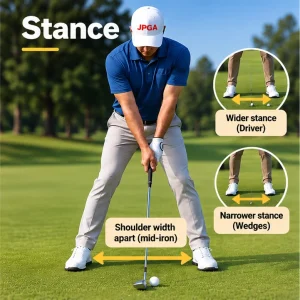
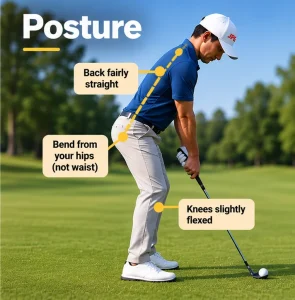
With a mid-iron, set your feet about shoulder width apart. Wider for the driver, a little narrower for wedges. Your weight should feel balanced across the middle of both feet, not on your toes or heels. Flex your knees slightly, like you are about to sit on a tall stool.
Posture
Bend forward from your hips, not your waist. Keep your back fairly straight and let your arms hang naturally from your shoulders. Good posture lets you turn freely. Bad posture makes you reach, sway, or stand up through impact.
PRO TIP
Set up in front of a mirror or film yourself from the side. Check that your spine is tilted forward, your knees are soft, and the ball is in the right spot for the club. It takes two minutes, and it fixes more swings than any fancy drill.
The Perfect Golf Swing, Step by Step
There is no single “perfect” swing. Look at the best players in the world and you will see plenty of style differences. But the best swings all share the same building blocks. Here is the sequence, broken into simple steps.
| Step | What Happens | What to Feel |
|---|---|---|
| 1Takeaway | Club, hands, and chest move away together | One smooth, low move. No snatching it inside. |
| 2Backswing | Shoulders turn, arms lift, weight loads into the back side | Coiling like a spring, not swaying off the ball |
| 3Transition | Lower body starts the change of direction | Hips lead, arms follow |
| 4Downswing | Weight shifts forward, club drops into the slot | Pressure moving into your front foot |
| 5Impact | Hands lead the clubhead, chest faces the target | Compressing the ball, then the turf |
| 6Follow-Through | Body rotates fully, balanced finish | Belt buckle facing the target, holding the pose |
Two things matter more than the rest. First, the swing is a chain reaction. Your legs and hips start the downswing, then your torso, then your arms, then the club. When that order gets scrambled, power leaks out and the ball goes anywhere. Second, tempo matters. A smooth swing beats a rushed one almost every time.
Golf Swing Tips for Beginners
If you are new to golf, here is the best advice I can give. Do not try to fix everything at once. Pick one thing, work on it for a week, then move on.
- Make solid contact first: Forget distance for now. Learn to hit the middle of the clubface, again and again, with a half swing. Confidence grows from solid contact.
- Start with shorter clubs: A 7-iron or 8-iron is easier to control than a driver. Build a repeatable motion there, then move up the bag.
- Keep your head steady, not frozen: Your head can rotate a little, but it should not lunge up and down. A quiet head helps you strike the ball cleanly.
- Finish your swing A full, balanced finish tells you the swing was in sequence. If you fall back or stumble, something earlier went wrong.
- Learn the short game too: Putting, chipping, and pitching make up a big share of your score. A great swing helps, but a good short game saves strokes fast. For a shot that works well in tricky conditions, check out our guide to the knockdown shot.
How to Improve Your Golf Swing Speed
Swing speed is one of the biggest keys to distance. More speed, with solid contact, means longer shots. But swinging harder is not the answer. Swinging smarter is. Here is where real speed comes from.
1. Use the ground
Fast swings start from the feet. Push into the ground in your downswing and let that force travel up through your legs, hips, and torso. Strong players are not arm swingers. They are ground-force players.
2. Build mobility and strength
If you cannot turn your shoulders and hips, you cannot make a big, powerful coil. Add hip, thoracic spine (upper back), and shoulder mobility work. Pair it with core, glute, and leg strength training. Even 15 to 20 minutes a few times a week helps.
3. Keep the lag
Lag is the angle between your lead arm and the club on the way down. Keep that angle longer, then release it right through impact. Casting the club early, from the top, throws away speed.
4. Fix your sequence
Speed comes from the right order of movement, not raw muscle. Start the downswing with your lower body, then let everything else catch up. A good sequence adds speed without adding effort.
5. Train speed on purpose
Use light-and-fast swing drills, such as swinging a lighter club or a speed stick, always with good form. Short, regular sessions train your body to move faster. Keep tension out of your hands and arms. For more on adding yards, read our post on easy tips to increase your driving distance.
KEY TAKEAWAY
Do not chase speed at the cost of contact. A swing that is 3 mph slower but hits the center of the face every time will beat a wild, fast swing on the scorecard.
Common Swing Mistakes (and Quick Fixes)
| The Problem | What Usually Causes It | The Fix |
|---|---|---|
| Slice | Open clubface, out-to-in path | Strengthen your grip slightly and swing out toward right field |
| Hook | Closed face, overly inside-out path | Check grip, then practice a neutral takeaway |
| Thin or fat shots | Early standing up, weight stuck on back foot | Keep your posture through impact and shift forward |
| Loss of power | Arms-only swing, no lower body | Start the downswing with your hips and push into the ground |
| Inconsistency | Changing tempo and setup every shot | Build a simple pre-shot routine |
Three Simple Drills You Can Try This Week
The Pause Drill
Swing to the top, pause for one full second, then swing down. This builds a smooth transition and stops you from rushing from the top.
The Feet-Together Drill
Hit short shots with your feet close together. It forces balance and a quiet lower body. If you wobble, your swing is too fast or too loose.
The Towel Drill
Tuck a small towel under both armpits and make half swings without letting it drop. This keeps your arms and chest connected through the swing.
Why You Need a Coach to Improve Faster
You can learn a lot from articles and videos. I hope this guide helps. But here is the truth after years of coaching junior golfers: most players cannot see their own swing. What feels like a straight takeaway might be a big inside loop. What feels like a full turn might be a short, handsy move. That gap between feel and reality is where progress gets stuck.
A qualified coach closes that gap. Here is what changes when you work with one.
- You get an expert eye: A PGA coach can spot the real cause of a miss in minutes. A slice might look like a grip problem but turn out to be a path problem from the top. Without a trained eye, you can spend months fixing the wrong thing.
- You get proof, not guesswork: Video analysis lets you see your swing side by side with the positions you are aiming for. Seeing it on screen makes changes click much faster than trying to feel them.
- You get a plan: Random range sessions rarely lead to real change. A coach builds a step-by-step plan, picks the right drills for your swing, and keeps you from piling on new tips every week.
- You build good habits, not bad ones: Bad habits get harder to undo the longer you practice them. Early coaching helps you groove the right moves from day one.
- You stay accountable: Improvement takes steady reps and honest feedback. A coach keeps you on track and celebrates the wins along the way.
How JPGA Helps Young Golfers Build a Better Swing
At Junior Players Golf Academy, swing improvement is at the heart of what we do. Our PGA-qualified coaching staff works one on one and in small groups with junior golfers of all levels, from first-timers learning the grip to competitive players chasing college golf. We use video analysis to show each golfer what is really happening, then build a clear plan to fix it.
Our golfers also get structured daily practice, real tournament experience, and a team culture that pushes them to get better every week. For families looking for a deeper commitment, our Full-Time Academy pairs
top-tier coaching with school and a full competitive schedule. And for players aiming at the next level, our college golf counseling helps turn swing gains into recruiting results.
If you want to see where we train, learn more about our Hilton Head Island campus, or read our guide to the best junior golf academies in South Carolina.
Frequently Asked Questions
How long does it take to improve a golf swing?
It depends on your starting point and how often you practice. Many golfers notice better contact within a few weeks of focused work with a coach. Bigger swing changes take a few months to feel natural. Steady, guided practice beats long, random sessions.
What is the easiest way to improve my golf swing at home?
Work on your grip, posture, and tempo using slow-motion swings in front of a mirror. Add mobility work for your hips and upper back, and film your swing from the side and from behind to spot problems.
How can I increase my golf swing speed quickly?
Focus on using the ground, keeping your lag, and improving your sequence from the lower body up. Add strength and mobility training, and use light-and-fast swing drills. Keep your contact solid, because speed means little without it.
Do I really need a golf coach?
Many kids start learning the basics between ages 6 and 8, but it is never too late to begin. A good coach shapes the lessons around your child’s age, strength, and goals so golf stays fun and progress stays steady.
What age should a child start working with a golf coach?
You can improve on your own, but a coach speeds up the process. A trained eye finds the real cause of your misses, and a clear plan keeps you from wasting time on the wrong fixes. This is especially true for young golfers who are still building their habits.

Add Comment