
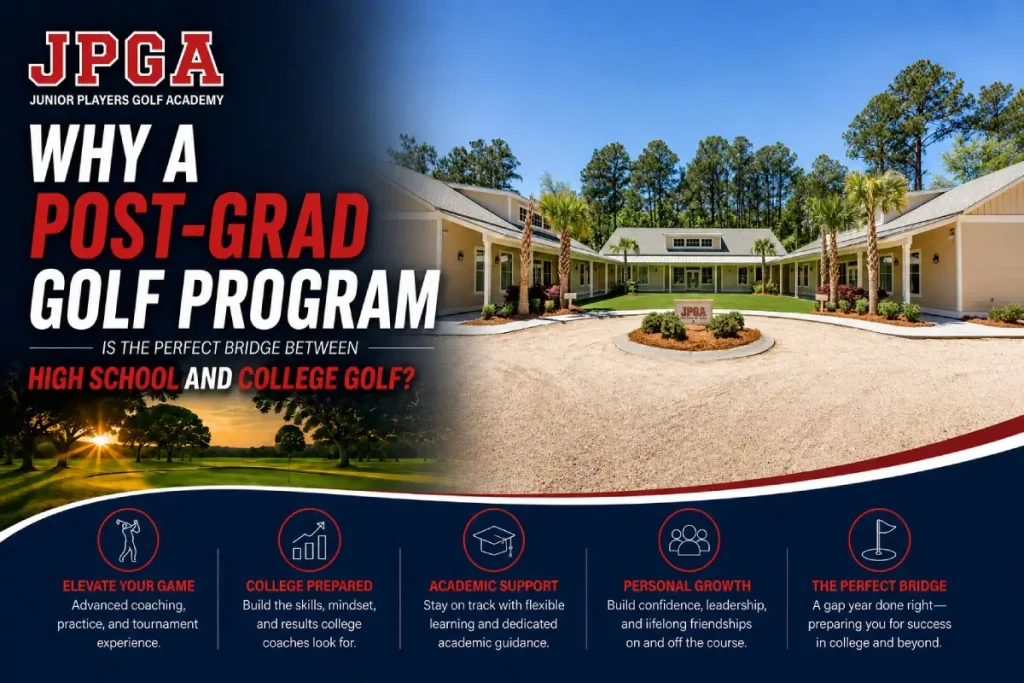
Why a Post-Grad Golf Program is the Perfect Bridge Between High School and College Golf?
by Keith Bach · PGA Member, President and Director of Instruction JPGA (Also called JRPGA)
A few years ago I had a kid on my range who had just walked off his high school graduation stage. Great swing. Silky short game. A trophy case full of local wins. He looked at me and said, “Coach, I’m basically ready for college golf, right?“
I let him hit a few more balls before I answered that one.
He was talented. He was not ready. And almost nobody is, not because they lack the game, but because high school golf and college golf are not the same sport wearing different jerseys. College coaches want players who already look like they belong: guys and girls who can grind through four rounds in three days, keep their cool when the wind kicks up on 17, and shoot a number on a course they have never seen in their life. Most 18 year olds simply have not banked enough reps to do that yet.
“High school golf and college golf are not the same sport wearing different jerseys.”
Our Locations
Hilton Head Island, SC
2 Finch Street
Hilton Head Island, SC 29926
Orlando, FL
16301 Phil Ritson Way
Winter Garden, FL 34787

That gap is real, and it is exactly why I tell almost every serious junior golfer the same thing: a post-grad golf program is the perfect bridge between high school and college golf. I have watched it close that gap dozens of times, and it is the entire reason our post-grad program exists at Junior Players Golf Academy (JPGA). Let me walk you through why, no sales pitch, just what actually happens during that year.
First, What Even Is a Post-Grad Golf Year?
Picture a bridge for a second. Not a metaphor, an actual bridge. You do not leap across a canyon on faith. You walk across something solid built to get you from one side to the other.
That is what a post-grad year is. A structured, focused year of golf between high school graduation and freshman year of college, built around three pillars: technical coaching, physical conditioning, and mental training. Not a break. Not a gap where nothing happens. If anything, it is the opposite of a gap year in the lazy sense of the word.
4+
YEARS OF COLLEGE
COMPETITION AHEAD
2nd
RECRUITING SEASON, NOT YOUR LAST
1
FOCUSED YEAR BUILT
AROUND YOUR GAME
3
PILLARS: SWING, FITNESS, MENTAL GAME
What a Post-Grad Year Actually Includes
Here is how we build that year, broken down the way I explain it to families on their first call.
DAILY COACHED PRACTICE
Limited student to teacher ratios and real swing and course management work, not just open range time with no plan.
FULL TOURNAMENT SCHEDULE
A season built around real tournament competition, so players face the pace and pressure of college golf before they ever arrive on campus.
TPI FITNESS TRAINING
A strength and conditioning plan built on Titleist Performance Institute principles, tailored to a growing junior athlete’s body.
TRACKMAN AND V1 ANALYSIS
Launch monitor and video data so athletes see exactly what is happening in their swing, not just hear a coach describe it.
The Problem Nobody Tells You About High School Golf
Here is the part that catches families off guard. You are cruising along in your junior and senior year. Team practice three days a week. Your coach handles the schedule. Life is good.
Then graduation happens, and all of that structure just vanishes overnight. No more team. No more built-in practice schedule. No more coach reminding you when the next qualifier is. If you have ever typed “how to keep playing golf after high school” into Google at 11pm, this is exactly the moment I am talking about.
A post-grad program is the fix, and it is the specific problem this kind of program is built to solve. We rebuild your week around swing work, course strategy, lifting, and tournament prep, with coaches tracking you the same way a college staff eventually will. I have watched golfers walk in during June barely cracking their state’s top 50, and walk out the following spring with a national ranking. Same talent. The only difference was a full year of uninterrupted, coached repetition.
What Are the Benefits of College Golf for Aspiring Pros?
Short answer: they are bigger than most 18 year olds realize, and it is not close. Here’s why:
- You get four more years of reps before your paycheck depends on it. Almost every player on the PGA Tour and LPGA Tour right now came up through college golf.
- Your practice partners are also trying to go pro. Grinding next to teammates chasing the exact same dream raises your floor, not just your ceiling, which is why we keep our post-grad groups small and competitive.
- You build the mental game the tour actually demands. Sports psychologists, strength coaches, and a locker room full of people who care as much as you do.
- People are actually watching. College tournaments are where agents, equipment reps, and tour insiders show up. Our tournament schedule and coaching staff relationships with college programs exist specifically to put players in front of the right people at the right time.
ASK YOURSELF THIS
Do you already have a college offer you want to be ready for on day one? Or are you still trying to get seen at all? Either way, a post-grad year buys you a second, stronger season to make it happen. And while you are tightening up your recruiting timeline, it is worth knowing what coaches actually look for in a tournament round, so give our guide to preparing for a golf tournament a read too.
The Scholarship Conversation Every Parent Wants
Golf scholarships are brutally competitive, and coaches are not just recruiting talent, they are recruiting readiness. A post-grad year hands you a second, stronger recruiting season with a better scoring average, a fresher tournament résumé, and dedicated college placement support, because scholarship offers follow results, not potential.
It also buys you time to shore up your academics, which matters more than most families expect. When two golfers have similar talent, and they usually do, the one with better grades and test scores wins the tiebreaker almost every time.
And this is not just a boys’ conversation. Women’s golf scholarships have gotten just as competitive, with women’s college golf getting deeper every single year, and the math is identical.
The Part That Has Nothing to Do with Golf
College is a real adjustment. Doing that adjustment while also trying to win a spot in the fall lineup is a lot to hand an 18 year old at once. A post-grad year gives you a trial run at living away from home before you are also trying to survive organic chemistry. Our athletes live together in shared housing near our Hilton Head Island and Orlando facilities, so that independence gets built gradually, not dropped on them all at once on a college campus three states from home.
“They had already figured out the living on your own part the year before, so they only had one mountain left to climb instead of two.”
Final Thoughts
If you are a high school golfer with real college ambitions, and especially if you are already wondering how to become a professional golfer down the road, I think a post-grad year is one of the highest leverage years you will ever spend. That is the entire idea behind our post-grad program here at Junior Players Golf Academy: one year, built around getting you ready, not just to make a college roster, but to actually go compete once you are on it.
Frequently Asked Questions
What is a post-graduate year in golf?
A structured year of golf training and competition between high school graduation and college, built around coaching, fitness, and tournament reps to bridge the gap to college level play.
How do I keep playing golf competitively after high school?
Join a structured post-grad or gap year program. It replaces the team structure you lose after graduation with daily coaching, a real fitness plan, and a genuine tournament schedule
Does a post-grad year help with golf scholarships?
Yes. It gives you a second recruiting season, a stronger scoring average, fresher results against tougher competition, and more time to build your academic profile. College placement support during that year makes a real difference too.
Do post-grad golf programs help golfers trying to go pro?
Yes. Most professional golfers came up through college golf, and a post-grad year is usually what gets a player onto a college roster strong enough to prepare them for that next step.




Add Comment