
How to Shave 5–10 Strokes Off Your Score
A short game guide by Keith Bach, PGA Member, and President of JPGA
In more than two decades of teaching golf, I’ve worked with beginners who’d never held a club and competitive juniors chasing college scholarships. No matter the skill level, I get asked the same question in almost every lesson: “Keith, what’s the one thing I can do to actually lower my score?“
Most golfers assume the answer lies at the driving range: more distance, a faster swing, a new driver. But here’s the truth I share with every student, from juniors just starting out to lifelong weekend players. The fastest, most reliable way to lower your score isn’t found on the tee box.
It’s found within 30 yards of the green. If you can master one specific shot, the chip from the fringe or collar, you’ll shave 5 to 10 strokes off your score faster than working on almost anything else in your game.
Our Locations
Hilton Head Island, SC
2 Finch Street
Hilton Head Island, SC 29926
Orlando, FL
16301 Phil Ritson Way
Winter Garden, FL 34787
Phone: (843)-686-3355

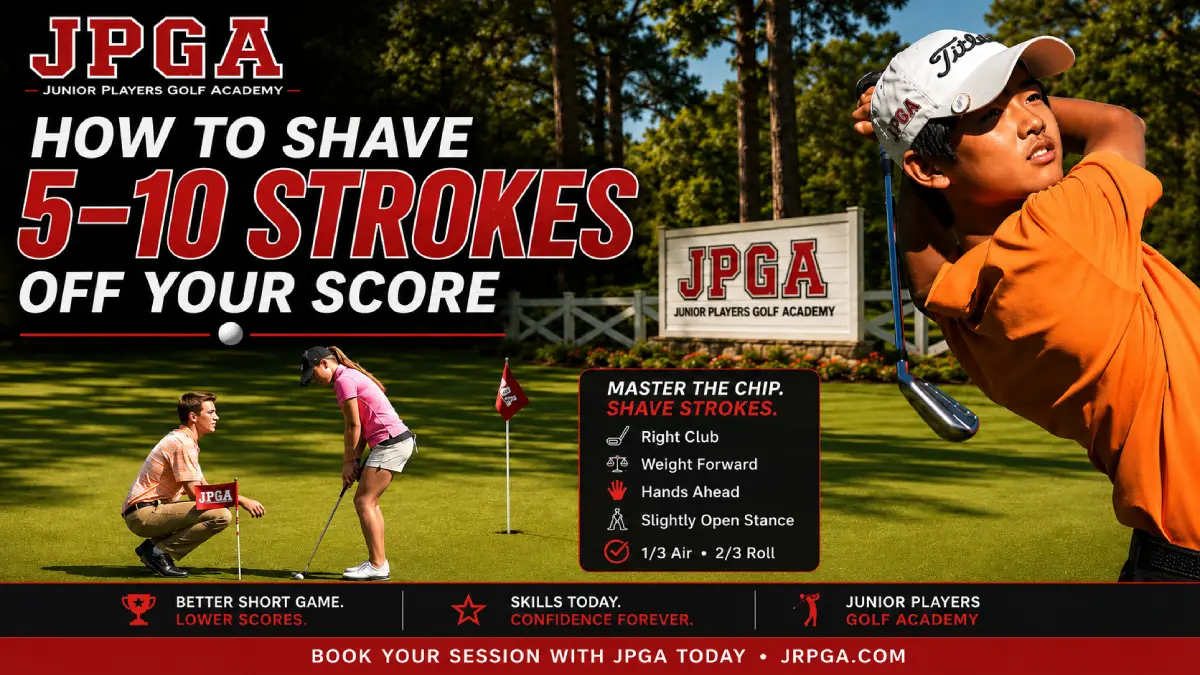
QUICK REFERENCE: THE 4-STEP CHIP
- Club: Wedge for a tight pin, 7 or 8 iron for a middle or back pin
- Weight: Favor your lead foot, roughly 60/40
- Hands: Ahead of the ball at address and through impact
- Stance: Slightly open to your target
- Goal: About 1/3 air time, 2/3 roll time
Why the Short Game Is Where Scores Are Made
Here’s something most golfers don’t realize. The average round includes far more short shots around the green than full swings. Every approach that misses the green, every layup, every recovery shot leaves you with a delicate shot from just off the putting surface. If you can turn those situations from bogeys into pars, your scorecard changes dramatically, without you swinging harder or buying new equipment.
The Situation: Ball Just Off the Green
Picture this scenario, because you’ve faced it a hundred times. Your ball comes to rest just off the putting surface, on the collar, the fringe, or the apron. This is one of the most common situations in golf, and also one of the most mishandled.
Step 1: Club Selection Comes First
THE RULE OF THUMB
- Flag close to the edge of the green: Use a wedge.
- Flag in the middle or back of the green: Use a 7 iron or 8 iron.
Your goal on this shot is not to fly the ball through the air. It’s to get the ball rolling like a putt as early as
possible.
Step 2: Put the Lob Wedge Away
A high lofted club dramatically shrinks your margin for error. Save your lob wedge for shots where you genuinely need height. For the everyday chip from the fringe, less loft means less that can go wrong.
Step 3: Build a Setup That Sets You Up for Success
- Weight forward: Favor your lead foot, roughly 60/40.
- Hands ahead of the ball: At address, with the shaft leaning slightly toward the target.
- Stance: Slightly open to your target line.
Step 4: Trust the Setup and Let the Club Work
With your weight forward and hands leading the clubhead through impact, the club naturally pinches down on
the back of the ball, producing roughly 1/3 air time and 2/3 roll time.
Common Mistakes I See (and How to Fix Them)
- Trying to help the ball into the air: Let the club’s loft do the work; don’t scoop.
- Decelerating through impact: Commit to a smooth, accelerating stroke.
- Ball position too far forward: Keep it center or slightly back in your stance.
- Using one club for every situation: Adapt your club based on green depth and pin placement.
Practice Makes Permanent
- Drop 10 to 15 balls just off the fringe at varying distances.
- Alternate between two or three clubs.
- Pick a landing spot just onto the green.
- Track how many shots finish within a 3-foot circle of the hole.
Frequently Asked Questions
A few more things players and parents ask me
What club should I use to chip around the green?
Use a wedge when the flag is close to the edge of the green, and a 7 or 8 iron when the flag is in the middle or back.
Why do I keep chunking or skulling my chip shots?
Usually it comes down to setup and club choice. Moving your weight forward and choosing less loft will clean this up quickly.
How much loft do I actually need for a chip shot?
Less than most golfers think. A mid iron gives you more roll, control, and a more repeatable shot.
How many strokes can better chipping really save me?
For most recreational golfers, this one shot is worth 5 to 10 strokes over a full round.
Take Your Game Further With JPGA
The chip shot in this guide is just one of the fundamentals we teach every day at Junior Players Golf Academy (JPGA or also regarded as JRPGA sometimes). Whether you’re a weekend player looking to shave strokes or a junior chasing a college scholarship, our PGA-certified instructors can help you turn tips like this into real results on the scorecard.
Train with JPGA:
- Multi Day Golf Schools in Orlando and Hilton Head Island.
- Online instruction from anywhere.
- Junior golf schools and camps through our Junior Players Golf Academy.


Add Comment