

Golf Water Hazards And Penalty Areas Explained: Red Vs Yellow Stakes
by Keith Bach · PGA Member, President and Director of Instruction JPGA (Also called JRPGA)
HOW MANY STROKES YOU ADD WHEN YOUR BALL GOES IN THE WATER
Every golfer hits one in the water sooner or later. I have seen tour pros do it. I have seen my own players do it on the biggest day of their season. What matters is what happens next. If you know the golf water hazard rules, one splash costs you one stroke. If you do not, it can cost you the whole hole.
This guide breaks it all down in plain language: what a penalty area is, red vs yellow stakes, how many strokes you add when your ball goes in the water, and the three ways to get back in play.
What Is a Penalty Area in Golf?
A penalty area is a part of the course marked by the committee where a ball is hard to find or hard to play. Most of the time it is water, like a pond, creek or marsh. But it can also be thick woods, a rocky ditch or a dry creek bed.
You may still hear people say “water hazard.” That was the official name until the Rules of Golf changed in 2019. Today the right term is penalty area, and it comes in two colors. Yellow stakes or lines used to mean a “water hazard.” Red stakes or lines used to mean a “lateral water hazard.” Same idea, new name. Players still search for both terms, so you will hear both on the course.
Our Locations
Hilton Head Island, SC
2 Finch Street
Hilton Head Island, SC 29926
Orlando, FL
16301 Phil Ritson Way
Winter Garden, FL 34787

Red vs Yellow Stakes: What Is the Difference?
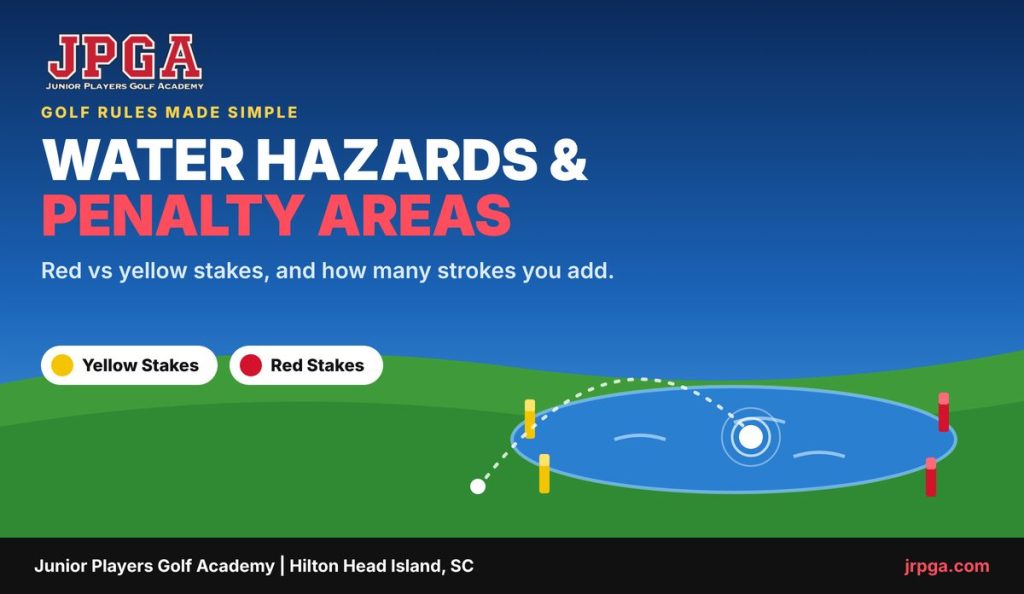
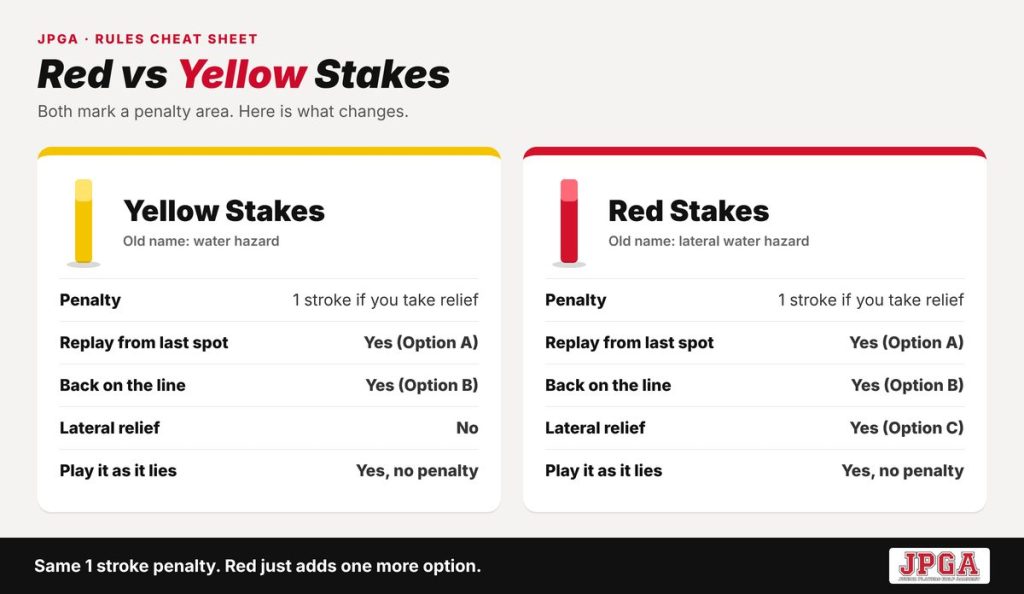
The color tells you which relief options you get. That is the whole difference. The penalty is the same for both.
KEY TAKEAWAY
Yellow gives you two options. Red gives you three. Check the stake color before you hit, because it can change your club choice and your plan.
Here is how I explain it to my players. Yellow stakes usually mark a pond or a stretch of water you would have to cross to reach the target. Red stakes usually run along the side of a hole, where it is hard to get back behind the water. That is why red allows an extra lateral water hazard rule: lateral relief on the side of the area where your ball went in.
How Many Strokes Do You Add When Your Ball Goes in the Water?
The penalty for hitting a ball in the water in golf is one stroke. That is true for red and yellow stakes, and it is true in stroke play and match play. You add one stroke to your score, then play your next shot from your relief spot.
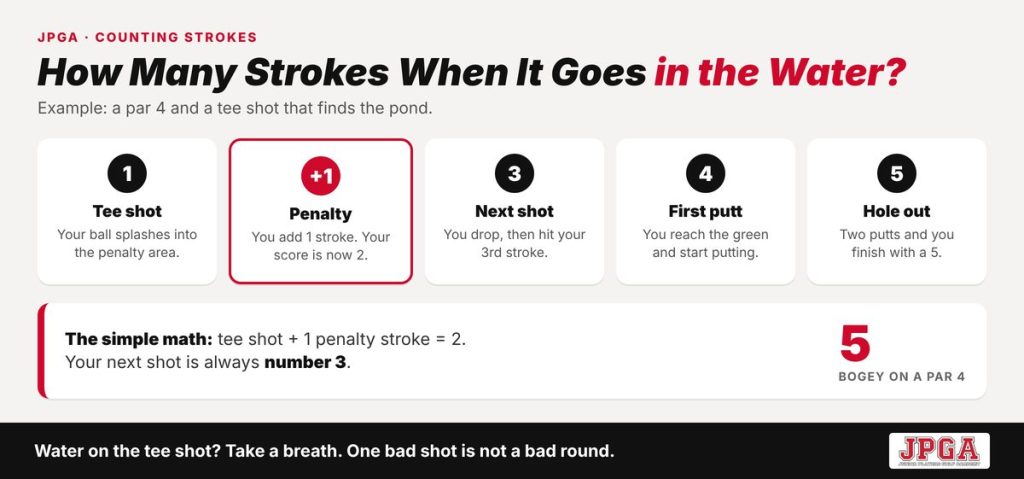
Let us walk through a par 4. Your tee shot is stroke one. The ball finds the pond. You add one penalty stroke, so your score is two. Your next shot is stroke three. If you hit the green and two putt, you finish with a five. That is a bogey, and the hole is over. Not a disaster.
Your Three Relief Options (And When You Can Use Each)
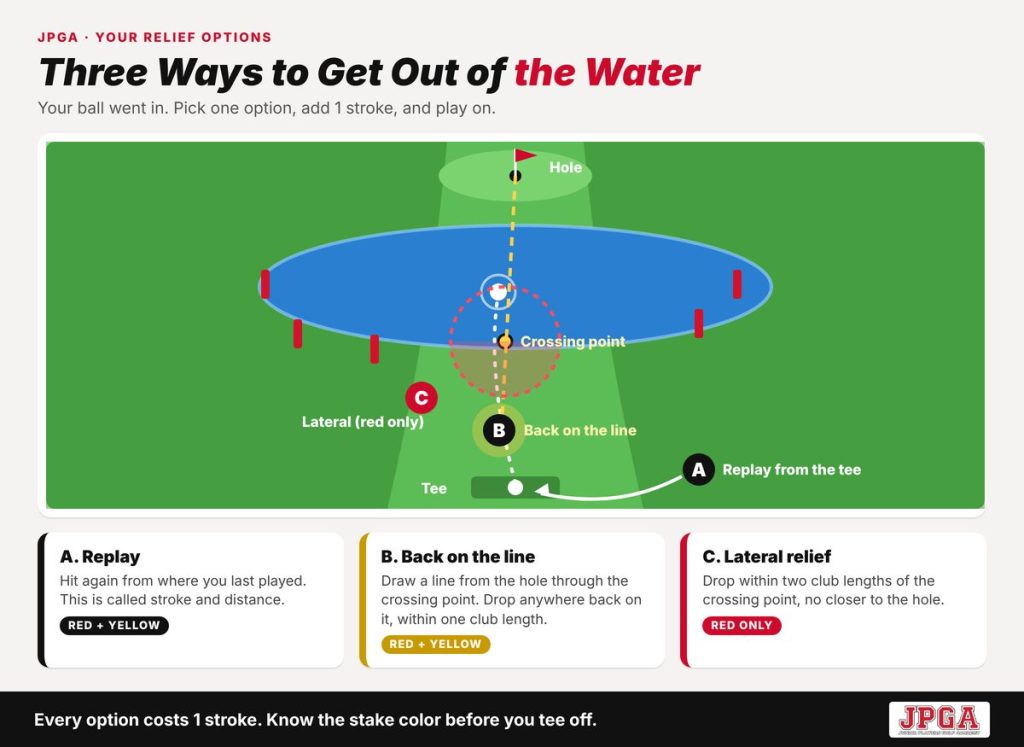
Once your ball is in a penalty area, you have choices. Every option costs one stroke. Here they are in simple terms.
Option A: Replay from where you last hit
Go back to the spot of your last shot and hit again. Golfers call this “stroke and distance.” Off the tee, you tee the ball up again. From the fairway, you drop a ball as close as you can to the old spot. It is the safe choice when the water is wide and the angle is tricky.
Option B: Back on the line
Find the spot where your ball last crossed the edge of the penalty area. Draw an imaginary line from the hole through that spot. Then go back along that line as far as you like and drop within one club length of it. The farther back you go, the more room you get to swing. This is the one most players forget, and it is often the best.
Option C: Lateral relief (red stakes only)
Take the same crossing point. Now drop within two club lengths of it, on either side, no closer to the hole. This is the lateral relief in golf option, and it only applies to red penalty areas. Yellow does not allow it.
When you drop, hold the ball at knee height and let it fall. It must land inside your relief area and stay there. If it rolls out, drop again. If it rolls out a second time, place the ball where it touched the ground on the second drop.
Can You Play the Ball From the Water?
Yes. Taking relief is never required. If your ball is in the penalty area and you can hit it, you can play it as it lies and there is no penalty at all. Since 2019 you can also touch the ground or water with your club in a penalty area before you swing.
My advice: only try it when the ball is sitting up in shallow water or mud and it is safe. Never step into water with snakes or gators in the picture, and never take a risky shot in a moving stream. One penalty stroke is far cheaper than a bad lie or an injury. On Hilton Head Island, where water shows up on almost every course, I tell my players to take the penalty and move on.
When Is It a 2 Stroke Penalty in Golf?
This is where many players get confused. A ball in a penalty area is only one stroke. The twostroke penalty is called the general penalty in stroke play. In match play, the general penalty is losing the hole. Here are the most common situations:
| Situation | Stroke Play | Match Play |
|---|---|---|
| Ball in a red or yellow penalty area (taking relief) |
1 stroke | 1 stroke |
| Ball out of bounds | 1 stroke and replay | 1 stroke and replay |
| Playing a wrong ball | 2 strokes | Loss of hole |
| Carrying more than 14 clubs | 2 strokes per hole, up to 4 |
Lose 1 hole for each hole in breach, up to 2 holes |
| Dropping or playing from the wrong place | 2 strokes | Loss of hole |
Want the full list of common mistakes? Read our guide to common golf penalties and how to avoid them. And if match play is new to you, start with stroke play vs match play.
Is Your Ball Really in the Penalty Area?
This one catches players all the time. To take penalty area relief, you must know or be virtually certain that your ball came to rest inside the area. Maybe you saw it splash. Maybe a playing partner saw it roll in. That counts.
If you are not sure, it is just a lost ball. A lost ball costs one stroke and you must go back and replay. So if your ball might be lost somewhere other than the water, like deep rough or trees near the pond, hit a provisional ball before you walk forward. It saves time and strokes. You get three minutes to search, and then the ball is lost.
How I Coach Water Shots at JPGA?
Water is a mental test as much as a physical one. Players stare at the pond, tighten up, and hit it right in. Here is the routine I teach.
- Check the stakes first: Know if it is red or yellow before you pull a club. It tells you what options you will have.
- Pick a target away from the water: Aim at the safe side of the green, not the flag. A 20-foot putt beats a penalty stroke every time.
- Take one more club: Most balls go in the water because they are short. Take the extra club and trust it.
- Mark the crossing point: If you do go in, watch where the ball crosses the edge. You will need that spot for Options B and C.
- Ask before you drop: In tournaments, find a rules official if you are unsure. It is always better to ask than to add penalty strokes.
Our players practice this in tournament play across the Hurricane Junior Golf Tour. Read our guide to the HJGT schedule and how to prepare for a golf tournament. Hilton Head is full of water, so it is also a great place to learn this skill. See why in our post on Hilton Head as a place to train.
Frequently Asked Questions
How many strokes is a water hazard?
One stroke. A ball in a red or yellow penalty area costs one penalty stroke if you take relief. If you play the ball as it lies, there is no penalty.
Is a water hazard a 2 stroke penalty?
No. A water hazard, now called a penalty area, is a one-stroke penalty. Two strokes is the general penalty for things like playing a wrong ball.
What is the difference between red and yellow stakes in golf?
Both are penalty areas with a one-stroke penalty. Yellow gives you two relief options (replay, or back on the line). Red gives you those two plus lateral relief.
What is a lateral hazard in golf?
It is the old name for a red penalty area. It is usually along the side of a hole, so you can drop within two club lengths of where the ball crossed the edge.
Can you ground your club in a water hazard?
Yes. Since 2019 you may touch the ground or water in a penalty area. There is no penalty for it.
What if my ball is in the water but I can still see it?
You can play it as it lies with no penalty, or take relief for one stroke. Only try the shot if it is safe.
At JPGA, rules knowledge is part of the training. Our players learn how to read a course, handle trouble and make smart decisions under pressure. If you are looking for a place where your child can build real skills and compete, learn more about our Hilton Head junior golf academy or our full-time junior golf academy program. You can also explore our guide to the best junior golf academy in South Carolina.




Add Comment