

Golf Tee Height: Should You Tee the Ball Low or High?
by Keith Bach · PGA Member, President and Director of Instruction JPGA (Also called JRPGA)

I see this all the time at the practice tee. A golfer walks up, sticks the tee in the ground without really looking, drops the ball on top, and swings away. They never stop to think about how they teed it up, even though that one small step can change the whole shot.
Tee height doesn’t get much attention. Most golfers would rather talk about swing speed or how far they can hit it than where a two inch peg sticks out of the ground. But the height of your tee actually changes what happens when you make contact with the ball. Get it right and your shots get better without you changing anything else about your swing.
Our Locations
Hilton Head Island, SC
2 Finch Street
Hilton Head Island, SC 29926
Orlando, FL
16301 Phil Ritson Way
Winter Garden, FL 34787
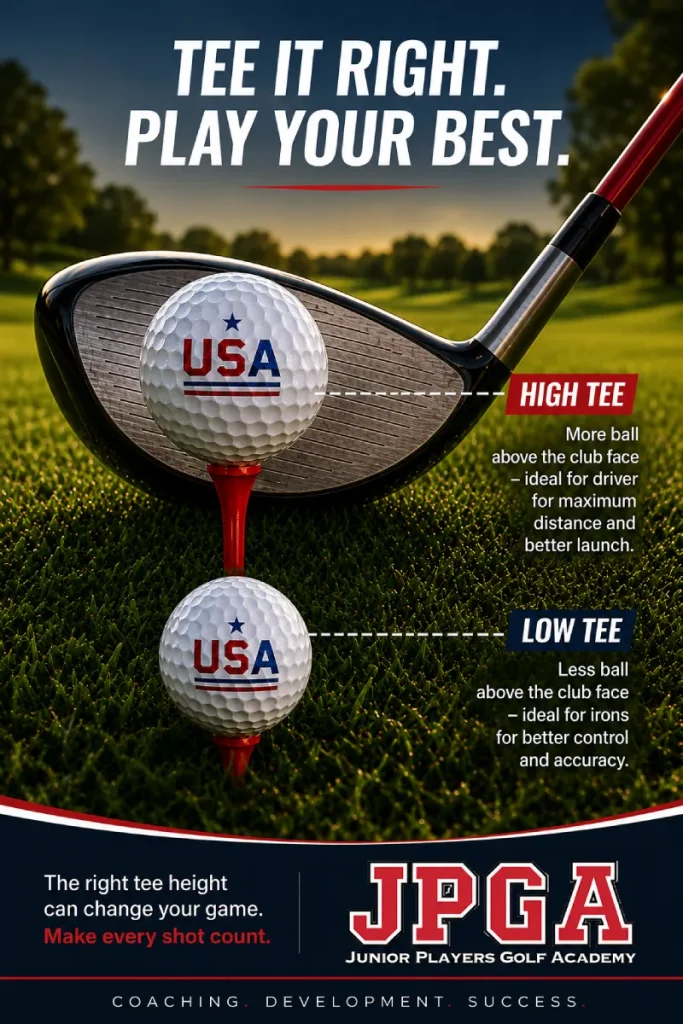
Do I Really Need to Tee My Ball?
Every single time the rules let you, yes. It doesn’t matter if you’re facing a drivable par 4 or a tight little par 3. Tee it up. A teed ball gives you a clean, repeatable strike instead of whatever the turf hands you, and repeatable strikes are how good rounds get built. It takes two seconds to push a tee into the ground. Skipping that step because you’re rushing to keep pace is one of the easiest strokes you’ll ever hand back to the course.
Why Tee Height Actually Matters More Than You Think?
I used to boil it down for students with one line: tee it high for the driver, low for the irons. That’s still true, but I’ve since looked into the numbers, and they back up exactly what good coaches have felt for years. MyGolfSpy ran a controlled test comparing a low tee height (about half an inch) against a higher one (about an inch and a half), using a launch monitor and the same driver for 120 shots at each height.
+14 yds
AVG. CARRY GAIN
+3.5°
MORE LAUNCH
−300 rpm
LESS BACKSPIN
4 mm
HIGHER FACE CONTACT
The higher tee also came with better strokes gained numbers and more fairways hit, not just more distance. That’s real distance and real accuracy from a two second adjustment you make before you’ve even taken a practice swing. Here’s why it works: a driver performs best when you catch the ball slightly on the upswing, striking it above the club’s center of gravity. Tee it too low and you’re forced to hit down on it or catch it low on the face, which spikes spin and steals both distance and control. Tee it too high and you risk a weak, ballooning shot off the top of the face that dies in the air. There’s a sweet spot, and finding it on purpose, every time, is what separates golfers who bomb it down the middle from golfers who are just hoping.
Tee Height, Club By Club
Here’s how I break it down for my students, and it’s simpler than it sounds once you’ve done it a few times.
DRIVER
Set the tee so the equator of the ball lines up with the top edge, or crown, of your driver at address. Hold the club next to the tee before you settle into your stance and adjust until it looks right. This height lets you catch the ball on the upswing and use the full face, especially the sweet spot, for maximum ball speed with minimal spin.
FAIRWAY WOODS
Go noticeably lower than your driver height. A good rule of thumb is that about half the ball should peek out above the crown, or you should just barely see the tee poking out of the ground. Fairway woods are shallower and meant to be struck with a slightly descending or level blow, so you don’t need nearly as much air under the ball.
HYBRIDS
Lower still. Push the tee almost all the way into the turf so only about a quarter of the ball shows above the crown. Hybrids already do the work of getting the ball airborne, so you don’t need to help them.
IRONS
Tee it so low the ball is basically sitting on the grass, with just enough tee to keep it off the dirt. Students ask me why bother teeing an iron shot at all if it’s essentially on the ground anyway. The answer is that even a sliver of a tee removes the risk of catching a divot, a soggy patch, or an uneven lie before you make contact.
The Mistake I See Most Often
Juniors love using one tee height for every club in the bag because it’s simple. It’s also exactly backwards. Use your driver height on an iron shot and you’ll pop it up weakly off the top of the face. Use your iron height on a driver and you’ll lose real distance while adding spin you didn’t ask for. Take the extra few seconds on every tee shot to match your height to the club in your hands. It becomes automatic with reps, and it’s exactly the kind of small habit worth locking in before your next start on the Hurricane Junior Golf Tour, where every stroke on your card matters.
TRY THIS ON THE RANGE
Next time you’re on the range, tee up ten balls with your driver at three different heights: low, medium, and the crown level height described above. Watch your ball flight on each one. You’ll see the difference with your own eyes faster than any explanation of mine can capture. While you’re tightening up the small stuff, it’s worth knowing the rules around tees and equipment too, since those trip up juniors more than you’d think. I put together a full rundown of common golf penalties and how to avoid them that’s worth a read.
Final Thoughts
Tee height is one of those small, unglamorous fundamentals that quietly separates the golfers who are consistent from the golfers who are still guessing. It costs you nothing, it doesn’t require rebuilding your swing, and it pays off in extra yards and extra fairways almost right away. Locking this in is exactly the kind of habit-level prep I talk about when I write about getting ready for a tournament, so give that a read too if you’re gearing up for your next event.
Frequently Asked Questions
What's the ideal tee height for a driver?
Line up the equator of the ball with the top edge, or crown, of your driver at address. For most standard drivers that puts about half the ball above the crown, roughly an inch to an inch and a half of the ball showing above the ground. Deeper-faced drivers may need a touch more.
Should I really tee up my irons, even just a little?
Yes. Push the tee in until the ball is basically sitting on the grass. It looks like you’re barely using the tee at all, but that sliver of height still protects you from a divot, a wet patch, or an uneven lie you’d otherwise have to play from.
What length golf tee should I actually buy?
Keep two lengths in your bag. A shorter tee, around 2 and 3/4 inches, handles irons, hybrids, and fairway woods. A longer tee, 3 and 1/4 inches or more, gives you room to set up your driver at the right height without burying it all the way into the ground.
Is there a rule about how high you're allowed to tee the ball?
Yes. Rule 6.2b in the official Rules of Golf caps tee length at 4 inches (101.6mm). Basically every tee sold at a golf shop falls well under that limit, but it’s worth knowing the rule exists, especially once you start playing sanctioned junior events.
How can I tell if my tee height is wrong?
Watch your ball flight. A driver shot that balloons weakly or feels like it came off the top of the face usually means you’re teed too high. A driver shot that flies low and spins out with no roll usually means you’re teed too low. For irons, if you’re occasionally catching the top of the tee or hitting behind it, you’re teeing too high for that club.




[…] it de-lofts the club before you’ve even taken the club back. If you’ve read my post on tee height, you already know how much a small setup change like this can shift your entire ball flight, and […]
[…] up short. Want the full breakdown of how to dial in your exact tee height? I wrote about it in tee height. If you haven’t tried teeing it higher than what feels normal, you’re probably leaving […]